



- Home
- Amine Scrubbing Technology
Amine Scrubbing Technology
Biogas Purification by Amine Scrubbing Technology
Our advanced Amine Scrubbing CO₂ & H₂S Purification System is specially designed to remove Carbon Dioxide (CO₂) and Hydrogen Sulphide (H₂S) from raw biogas through a highly efficient chemical absorption process using an amine solution.
The system selectively absorbs acidic gases such as CO₂ and H₂S, resulting in a purified methane-rich gas stream suitable for Bio-CNG production, power generation, industrial heating, and vehicle fuel applications.
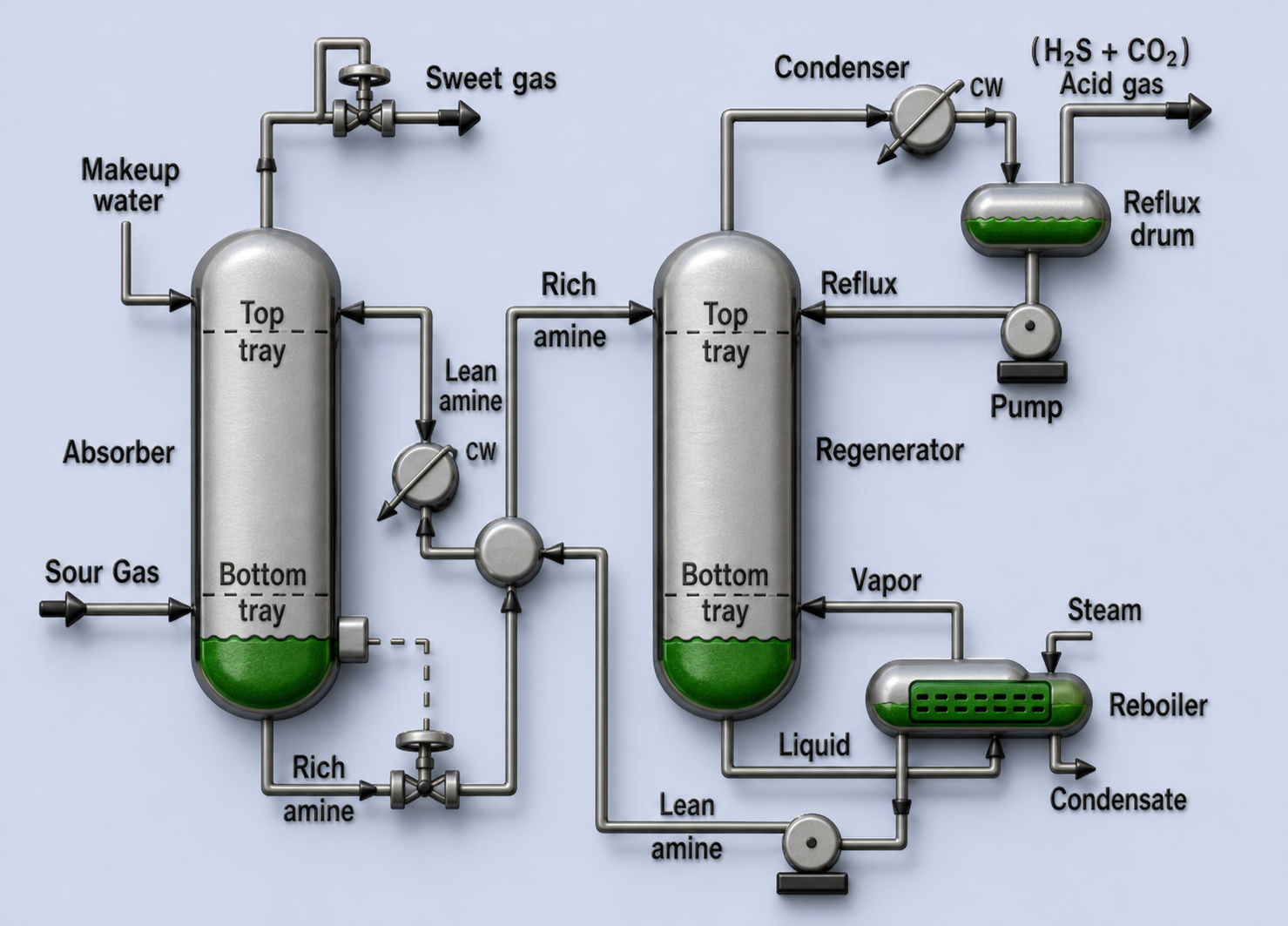
Process
1. Gas Pressurization
Raw biogas generated from the digester is initially pressurized using a gas blower to approximately 0.6 kg/cm²g. This provides the required operating pressure to overcome system pressure losses and ensure smooth gas flow through the purification system.
2. CO₂ & H₂S Removal by Amine Absorption
The pressurized biogas enters the Amine Absorber Column, where it comes into contact with the amine solution (MEA – Monoethanolamine).
During this process:
- Carbon Dioxide (CO₂) is selectively absorbed
- Hydrogen Sulphide (H₂S) is also effectively removed
- The remaining gas stream becomes rich in methane (CH₄)
This stage significantly improves the methane concentration and gas quality.
3. Methane-Rich Gas Separation
After absorption, the purified methane-rich gas exits from the top of the absorber column while the CO₂ & H₂S-rich amine solution is collected for regeneration.
The purified gas is then transferred to the downstream treatment section.
4. Gas Dehumidification
The methane-rich gas passes through a Dehumidifier to remove moisture and condensable water vapors from the gas stream.
This ensures:
- Better gas quality
- Protection of downstream equipment
- Improved compression efficiency
5. Methane Drying & Compression
The dry purified methane gas is further compressed using a gas compressor and prepared for:
- Cylinder filling
- Cascading systems
- Pipeline injection
- Industrial or vehicle fuel applications
The final output is high-purity Bio-CNG / Renewable Natural Gas (RNG).
6. CO₂ & H₂S Stripping (Amine Regeneration)
The CO₂ & H₂S-rich amine solution is transferred to the Stripper Column (Regenerator), where the absorbed gases are released from the solvent by heating the amine solution.
The required thermal energy is supplied through steam generated from a boiler.
This regeneration process restores the absorption capacity of the amine solution for continuous reuse.
7. CO₂ Rich Gas Venting / Recovery
The desorbed gas stream, commonly known as CO₂ Rich Gas, contains a high concentration of carbon dioxide along with traces of other separated gases.
Depending on project requirements, this gas can be:
- Safely vented
- Further purified
- Compressed for industrial CO₂ applications
- Utilized in downstream processes
8. Amine Cooling & Recirculation
After regeneration, the hot amine solution passes through:
- A Heat Exchanger
- A Water-Cooled Cooler
The solution is cooled to near ambient temperature and recirculated back to the absorber column for reuse in the purification cycle.
This closed-loop operation reduces solvent loss and improves operational efficiency.
9. Heat Recovery System
The system is designed with an energy-efficient heat recovery arrangement where approximately 60% of process heat can be recovered.
The recovered heat can be utilized for:
- Digester heating
- Hot water generation up to 55°C
- Process energy optimization
This significantly reduces overall plant energy consumption and operating cost.
Key Advantages of Amine Scrubbing Technology
- Simultaneous removal of CO₂ and H₂S
- High methane recovery efficiency
- Suitable for medium and large Bio-CNG plants
- Continuous and stable operation
- High-purity Bio-CNG output
- Lower methane losses
- Energy-efficient heat recovery system
- Reliable and proven industrial technology
Applications
- Bio-CNG Plants
- Compressed Biogas (CBG) Projects
- Renewable Natural Gas (RNG) Systems
- Industrial Fuel Gas Applications
- Vehicle Fuel Applications (Cars, Trucks, Buses & Tractors)
- Power Generation Systems