



- Home
- CO2 Water Scrubbing Technology
CO2 Water Scrubbing Technology
Biogas Purification by CO2 Water Scrubbing Technology
Advanced CO₂ Removal & Methane Enrichment System for Bio-CNG Plants
Water Scrubbing Technology is one of the most reliable and widely used methods for biogas purification and Bio-CNG production. The process is designed to remove carbon dioxide (CO₂), hydrogen sulfide (H₂S), moisture, and other impurities from raw biogas, resulting in high-purity methane gas suitable for Bio-CNG applications, industrial use, and vehicle fuel.
The system operates on the principle of physical absorption, where CO₂ present in biogas gets dissolved into water under pressurized conditions. Since carbon dioxide is highly soluble in water compared to methane (CH₄), effective separation can be achieved through a specially designed absorption process.
This technology offers stable performance, low methane loss, reduced operating cost, and continuous gas purification for medium and large-scale biogas plants.
Why Biogas Purification is Important
Raw biogas generated from organic waste, press mud, food waste, cow dung, sewage sludge, and industrial waste contains unwanted gases such as:
- Carbon Dioxide (CO₂)
- Hydrogen Sulfide (H₂S)
- Moisture
- Siloxanes
- Dust particles
These impurities reduce the calorific value of biogas and can damage downstream equipment such as compressors, cascades, engines, and pipelines.
Biogas purification improves:
- Methane concentration
- Gas calorific value
- Compression efficiency
- Equipment life
- Bio-CNG quality
- Plant reliability and safety
Working Principle of Water Scrubbing Technology
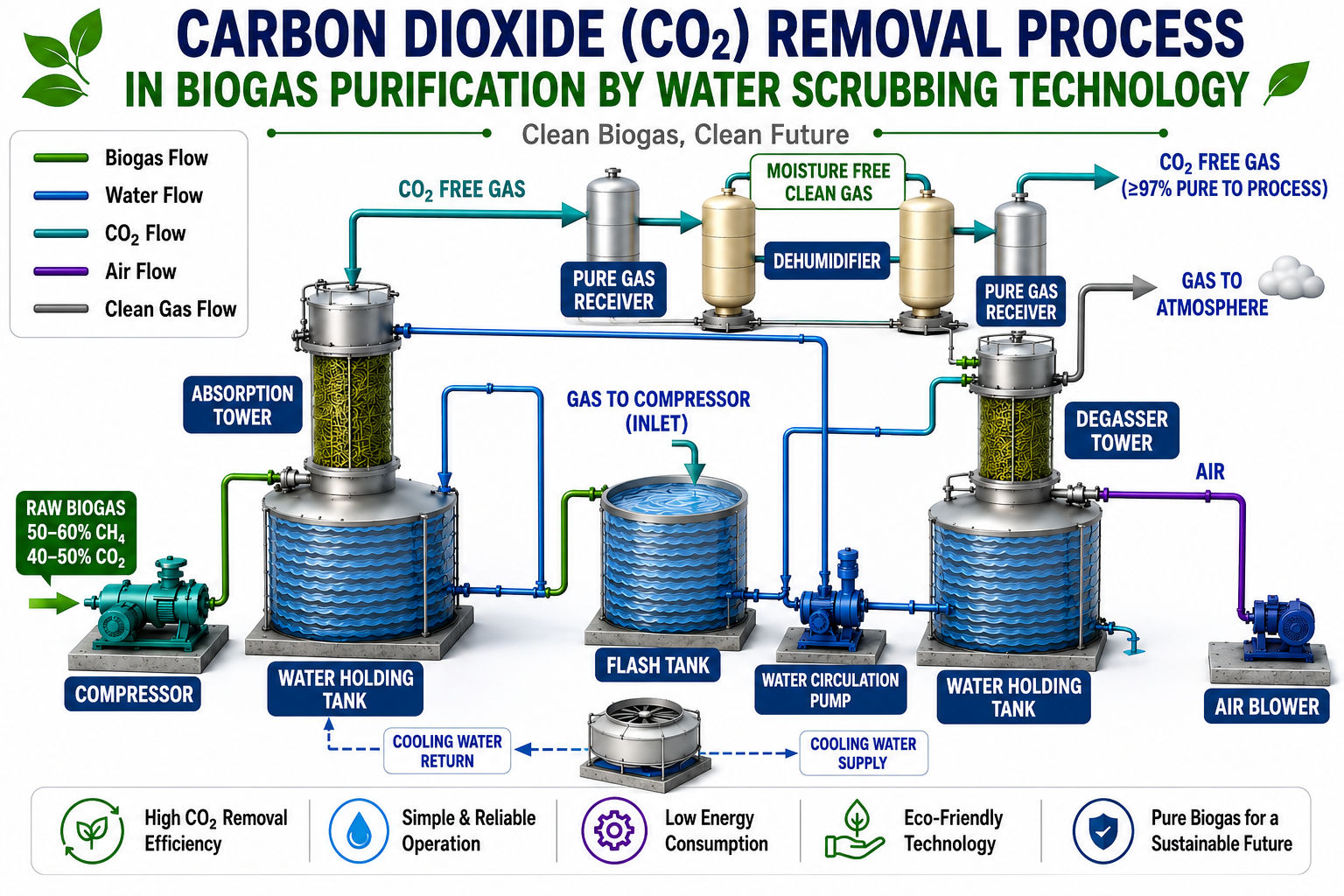
The purification process is carried out inside an absorption tower where raw biogas and pressurized water move in opposite directions in a counter-current flow arrangement.
As the raw biogas rises upward and water flows downward, CO₂ and traces of H₂S dissolve into the water due to their higher solubility, while methane gas remains largely unaffected and exits from the top as purified gas.
The complete system includes:
- Absorption Tower
- Water Circulation System
- Dehumidification Unit
- Flash Tank for Methane Recovery
- Degassing Tower
- Water Recycling System
- Gas Analysis & Monitoring System
By continuously circulating and regenerating the water, the system achieves efficient and economical gas purification with minimal water consumption.
Process Description of Water Scrubbing System
1. Raw Biogas Compression
Raw biogas from the digester or gas holder is first passed through:
- Moisture separator
- Safety filters
- Blower or compressor system
The gas pressure is increased to the required operating pressure before entering the absorption tower.
Benefits:
- Stable gas flow
- Improved CO₂ absorption efficiency
- Better gas-liquid contact
2. CO₂ Absorption Process
Inside the absorption tower, biogas flows upward while pressurized water is sprayed from the top section of the tower.
The counter-current contact between water and biogas enables selective absorption of CO₂ and other soluble impurities.
Main Functions:
- Removal of CO₂
- Partial removal of H₂S
- Initial gas cleaning
Process Highlights:
- High-surface-area packing media improves gas absorption
- Pressurized operation enhances purification efficiency
- Methane-rich gas exits from the top of the tower
The CO₂-rich water collected at the bottom of the tower is transferred to the water holding tank for regeneration and reuse.
3. Dehumidification System
After the absorption stage, purified methane gas contains moisture due to contact with water during scrubbing.
The gas is therefore passed through a dehumidification unit to remove excess moisture and maintain proper gas quality.
Dehumidification Stage Includes:
- Moisture separator
- Chilling system (if required)
- Demister pads
- Condensate drain system
Advantages:
- Prevents corrosion
- Protects compressors and cascades
- Improves Bio-CNG quality
At this stage, an online biogas analyzer continuously monitors:
- Methane concentration
- CO₂ level
- Oxygen level
- H₂S concentration
- Gas pressure
The purified gas is then maintained at the required pressure for further compression and bottling.
4. Methane Recovery System
During the CO₂ absorption process, a small quantity of methane may also dissolve into the water.
To minimize methane losses and improve plant efficiency, the dissolved methane is recovered using a flash tank system.
Flash Tank Operation
The CO₂-rich water from the absorption tower enters the flash tank where pressure is suddenly reduced.
Due to depressurization:
- Dissolved methane gets separated from the water
- Recovered methane gas is collected efficiently
The recovered methane is then redirected to the compressor knockout drum and recycled back into the purification system.
Benefits:
- Reduces methane loss
- Improves overall methane recovery
- Enhances plant efficiency
- Reduces operating losses
5. Water Degassing & Recycling System
After methane recovery, the water still contains dissolved CO₂ traces.
This water is sent to a degassing tower for regeneration.
Degassing Process
Inside the degassing tower:
- Pressurized air is introduced from the bottom
- Water flows downward through packing media
- Counter-current air-water interaction strips dissolved CO₂ from the water
The released CO₂ is safely vented through an exhaust system.
Water Recycling
Once regenerated:
- The purified water is collected back into the water holding tank
- Water is continuously reused in the absorption tower
- Fresh water consumption is minimized
Advantages:
- Low water requirement
- Reduced operating cost
- Sustainable plant operation
- Continuous purification process
Main Components of Water Scrubbing System
Absorption Tower
High-efficiency packed tower designed for CO₂ absorption
Water Circulation Pumps
Provide continuous recirculation of process water.
Flash Tank
Recovers dissolved methane from CO₂-rich water.
Degassing Tower
Removes dissolved CO₂ from circulating water.
Dehumidification Unit
Maintains low moisture content in purified gas.
Compressor & Blower System
Maintains operating pressure and gas flow.
Gas Analyzer System
Continuously monitors gas purity and process parameters.
Water Holding Tank
Stores and recirculates process water.
Key Features of Water Scrubbing Technology
High Methane Purity
Produces methane-rich gas suitable for Bio-CNG applications.
Low Methane Loss
Integrated methane recovery system improves efficiency.
Water Recycling System
Minimizes fresh water consumption.
Chemical-Free Process
No hazardous chemicals required for CO₂ removal.
Continuous Operation
Suitable for 24×7 industrial operation.
Low Maintenance
Simple and reliable process design.
Eco-Friendly Technology
Environmentally sustainable gas purification solution.
Typical Performance Parameters
| Parameter | Typical Range |
|---|---|
| Methane Purity | 95% - 99 % |
| CO₂ Removal Efficiency | up to 99% |
| Operating Pressure | 6 – 10 Bar |
| Water Circulation | Continuous |
| Methane Recovery Efficiency | High |
| Plant Operation | Fully Automatic / Semi-Automatic |
Advantages of Water Scrubbing Biogas Purification
| Feature | Benefit |
|---|---|
| High Gas Purity | Better Bio-CNG quality |
| Water Recycling | Reduced utility cost |
| Methane Recovery | Improved profitability |
| No Chemical Usage | Green technology |
| Green technology | Stable plant performance |
| Low Maintenance | Reduced downtime |
| Continuous Purification | Suitable for large-scale plants |
Applications
Water Scrubbing Technology is widely used in:
- Bio-CNG Plants
- Biogas Upgradation Plants
- Municipal Waste Projects
- Food Waste Biogas Plants
- Distillery Waste Plants
- Dairy Waste Biogas Systems
- Sewage Treatment Plants
- Industrial Organic Waste Projects
Sustainable & Efficient Biogas Upgradation Solution
Water Scrubbing Technology provides a highly efficient, economical, and environmentally friendly solution for biogas purification and methane enrichment. With advanced CO₂ absorption, methane recovery, water recycling, and continuous purification capability, the system delivers reliable performance for modern Bio-CNG and renewable energy projects.