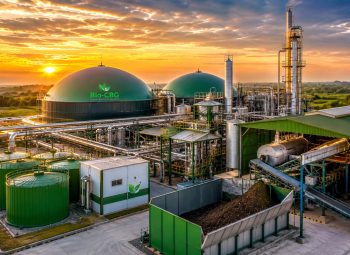



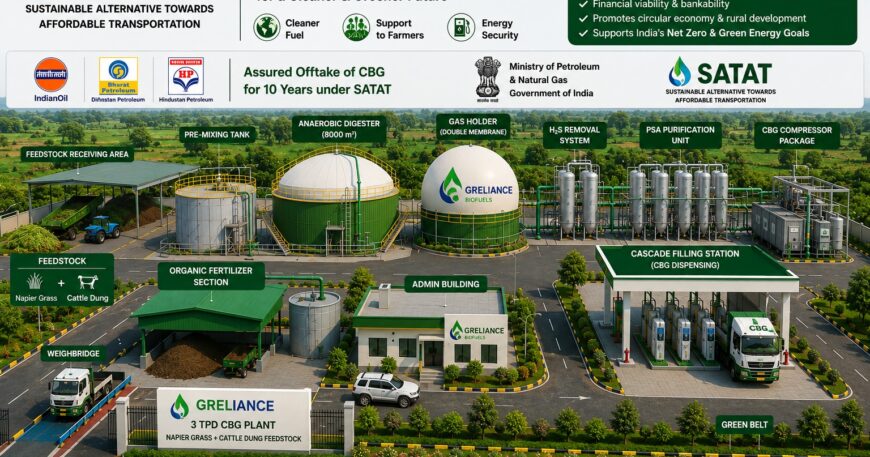
The SATAT (Sustainable Alternative Towards Affordable Transportation) scheme, launched by the Government of India, is a major initiative focused on promoting Compressed Biogas (CBG) as an alternative clean fuel for transportation, reducing dependence on fossil fuels, and supporting India’s renewable energy transition.
Under this scheme, private companies, cooperatives, and public sector undertakings are encouraged to establish Bio-CNG plants for producing compressed biogas from organic waste.
If you are planning to establish a Bio-CNG plant under the SATAT Scheme, obtaining an LOI (Letter of Intent) from Oil Marketing Companies (OMCs) such as:
- Indian Oil Corporation Limited (IOCL)
- Bharat Petroleum Corporation Limited (BPCL)
- Hindustan Petroleum Corporation Limited (HPCL)
is one of the most important initial steps.
The LOI ensures long-term offtake of your Bio-CNG production at a predetermined price, improving the bankability and financial viability of the project.
1. What is the SATAT Scheme?
Launched in 2018, the SATAT scheme aims to:
- Promote Bio-CNG as a clean transportation fuel
- Reduce dependence on imported fossil fuels
- Support waste-to-energy generation
- Encourage utilization of agricultural, municipal, and industrial waste
- Develop a nationwide Bio-CNG ecosystem
The Government of India aims to establish thousands of CBG plants across the country under this initiative.
2. Why is LOI Important?
An LOI from OMCs provides assurance that the produced Bio-CNG will be purchased at an agreed commercial price for a fixed period.
This helps in:
- securing project financing
- improving investor confidence
- ensuring stable long-term revenue
- reducing market risk
OMC Buyback Price Under SATAT
Typical OMC purchase price for CBG:
₹62–₹72 per kg
depending on:
- calorific value
- project location
- gas quality
transportation logistics
3. Eligibility Criteria for SATAT LOI
Before applying, ensure the following requirements are fulfilled.
Legal Entity Requirement
Applicant must be:
- Private Limited Company
- LLP
- Partnership Firm
- Cooperative Society
- PSU or Government Entity
Feedstock Availability
You must demonstrate long-term feedstock availability such as:
- Napier grass
- Cow dung
- Press mud
- Food waste
- Municipal waste
- Agricultural residue
Land Availability
Suitable land must be available for:
- digester installation
- purification system
- bottling section
- storage systems
- utility infrastructure
Financial Capability
Applicants should demonstrate:
- project funding capability
- bank support
- promoter contribution
- financial stability
4. Step-by-Step Process to Get SATAT LOI
Step 1 — Understand SATAT Guidelines
Study:
- technical requirements
- OMC specifications
- environmental regulations
- CBG quality standards
Visit the official SATAT portal for latest notifications and guidelines.
Step 2 — Prepare Required Documents
Prepare the following documents carefully:
Document | Requirement |
Company Registration | Mandatory |
Feedstock Agreement | Mandatory |
Land Documents | Mandatory |
DPR / Feasibility Report | Recommended |
Financial Documents | Mandatory |
Pollution NOC | Required |
Project Layout | Recommended |
Step 3 — Apply on SATAT Portal
Register on the SATAT portal and complete the application form.
Typical project details required:
- Plant capacity
- Feedstock type
- Project location
- Technology details
- Financing structure
Upload all supporting documents and submit the application.
Step 4 — Technical & Financial Evaluation
OMCs evaluate:
- project feasibility
- feedstock sustainability
- purification technology
- financial viability
- environmental compliance
Step 5 — Receive LOI
If approved, OMC issues LOI confirming Bio-CNG offtake commitment.
The LOI generally includes:
- quantity commitment
- gas quality standards
- pricing mechanism
- supply conditions
Step 6 — Final Offtake Agreement
After LOI:
- commercial agreement is finalized
- pricing terms are agreed
- delivery logistics are defined
- quality specifications are finalized
Step 7 — Financial Closure & Plant Setup
After obtaining LOI:
- banks can process funding
- EPC execution begins
- equipment procurement starts
- statutory approvals are completed
5. Common Challenges in SATAT Projects
Feedstock Supply Stability
Long-term feedstock contracts are critical for:
- stable gas generation
- lender confidence
- project viability
Environmental Approvals
Clearances may include:
- Pollution Control Board approvals
- Fire NOC
- Factory license
- PESO approvals
Financing Delays
Bank funding often depends on:
- promoter equity
- DPR quality
- LOI strength
- technology selection
Technology Selection
Improper purification technology can affect:
- methane recovery
- operating cost
- plant uptime
- profitability
Why Greliance Supports Water Scrubber Technology
At Greliance, we focus on designing reliable and efficient Bio-CNG purification systems with:
- high methane purity
- low operating cost
- reduced maintenance
- stable long-term operation
Compared to VPSA and PSA systems, Water Scrubber technology offers:
- lower maintenance requirements
- no costly molecular sieve replacement
- lower instrumentation dependency
- high purification stability
- reduced lifecycle operating cost
This makes Water Scrubber systems highly suitable for continuous Bio-CNG operations under Indian operating conditions.
Conclusion
The SATAT Scheme presents a major opportunity for developers, industries, and entrepreneurs to participate in India’s renewable gas ecosystem.
A properly planned project with:
- reliable feedstock
- correct purification technology
- strong DPR
- efficient plant design
can become a highly profitable long-term clean energy business.
At Greliance, we support clients with:
- Bio-CNG project development
- DPR preparation
- purification technology selection
- engineering support
- plant design
- process optimization
for successful execution of high-performance Bio-CNG projects across India.